Test....


READ MORE - Test




Built in 1895, Gedung Merdeka has a spesial history. Fifty years ago it was the scene of the first Asia-Africa Conference, which played a great role in changing the fates of many nations in Asia and Africa, especially those not yet independent back in 1955.
To prepare for the coming flashback to the 1955 Asia-Africa Conference, Gedung Merdeka is being thoroughly renovated. The most extreme change is in the interior: The conference halls are being restored to exactly as they were for the 1955 Conference. This year’s delegates will be able to indulge in nostalgia and re-experience the atmosphere of 1955.
 Gedung Merdeka has changed its function many times in its 110 years. It was first used as a coffe shop. Then, in 1928, it was remodelled by two Dutch architects and converted into a social hall for the Dutch community of Bandung, called Societeit Concordia.
 Later, in 1955, when Bandung was chosen to host the Asia-Africa Conference, Indonesia first President, Ir. Soekarno, changed the old building’s name from SocieteitConcordia to Gedung Merdeka, the “Freedom Building” and the name has stuck ever since.
Before it was converted into a museum, Gedung Merdeka was used as a conference hall and as the office for various high state instutions. As the 25th anniversary of the first Asia Africa Conference approached, it was proposed that the building be established as the Asia-Africa Conference Museum, and as the peak of the 25th anniversary commemoration, Indonesia’s second President, Soeharto, inaugurated the Asia-Africa Conference Museum on the site.
The museum’s collection deals mainly with the conference held fifty years ago: Photographs, books, and a diorama portraying Soekarno giving his openingspeech at the conference, with the Vice President and five sponsoring Prime Ministers in the background.
The 1955 Asia-Africa Conference had a significantimpact on world events. Around 79 Countries achieved independencein the years following the conference. The indicates that the conference resolution, the Bandung Principles, was more than mere words on paper.

Bali, the fabled “Island of the Gods”, has been enchanting visitors for centuries with its rich cultural tradition and spectacular panoramas. From lofty, mist enshrouded volcanoes and cool mountain lakes down through terraced rice field to a golden strand lapped by azure waters, every square inch of bali offers a fresh and unforgettable image.
No less enchanting are its people, some 2.7 million souls whose artistry and piety are recognized throughout the world. Balinese Hinduism, a complex fusion of indian cosmology, is the primary faith of Bali’s inhabitants, and so deeply woven into the fabric of their daily lives that the line between the spiritual and the material is blurry at best.
Those of you keen on delving into the island’s fascinating culture will have plenty of opportunities, as colourful ceremonies and traditional performances occur with the regularity of sunrise. Most hotels offer nightly dance showsof one form or another, tailored to tourist audiences but none the less exquisite. The will town of Ubud, the island’s premier arts centre, also has a full schedule of performances, and the nearby stone-cutter’s village of Batubulan is famed for its barong lion dances.
The shopper among you will find Bali a treasure house of handicrafts and fine works of art. The Balinese are incredibly gifted artists and craftsmen, and their material creations are imbued with the same sense of wondermentwith which the regard their universe. Stone and wood carvings, traditional and modern paintings and intricately designed jewelry in gold and silver are readily available in shops and galleries throughout the island.
As for recreation, there is no shortage of options. Nature walks, horseback riding, diving, surfing-efen bungy jumping and white water rafting-await the adventurous here.
 This island offers something more down to earth, and requires the spirit of adventure. Here, the main habitation is a fishing village with a camping ground and a home stay. There is also a seafood BBQ restaurant and souvenir shop. The island is accessible from Marina Ancol.

Pulau Seribu Marine Resort
Every city dweller dreams of being stranded on a desert island. Out here, you can be stranded in luxury. Consisting of two islands, the resort offers highly professional services, including delicious food and spacious cottages. Designed to let you enjoy nature, at the Marine Resort you can experience a variety of sports facilities and recreations or simply enjoy the beautiful white sandy beaches. The resort has more than 90 spacious cottages, on both the Timur (east) island and Barat (west) island. Each island is also equipped with tennis courts, a multinational restaurant, snack counter, souvenir ship, disco and marine sport rental ship, convention hall, scuba diving boat, swimming pool and japanese restaurant.

The House of Sampoernais everything that a museum should be but usually isn’t. Rather than a display of dry artefact from the past displayed in glass cases, the House of Sampoerna recreates history and shows its links to the living present, allowing the visitor to savour and enjoy rather than merely view and ponder.
In a single stately Dutch colonial-era compound, the museum tells the unfolding story of Sampoerna, the oldest and fastest growing manufacturer of kretek, the sweet smelling, clove scented, distinctly Indonesian tobacco product. The story begins with Liem Seeng Tee, a Hokkien immigrant who began his life as humble trader, selling flavoured tobacco from his small shop under a railroad bridge. Eventually, he concieved of the idea of selling pre-rolled cigarettes containing a blend of tobacco, cloves and other flavourings. His enterprise boomed, and within years he was the successful propieter of a major business. At the museum, the simple push bike that he first rode as an iterenant peddlar is on display as is the stretch limousine he bought several decades later. There is also a full range of photo and other momentoes from the company’s colourfull history, with pictures of the community brass band and testimonials from recipients of Sampoerna’s sholarships testifing to just how deeply the company is rooted in the social and cultural life of the region and nation.
But what makes the House of Sampoerna trully remarkable is that site of the museum adjoins a fully functional work unit of the present day company, where hundreds of nimble-fingered women workes hand-roll Sampoerna’s cigarettes at a dazzling speed. The visitor can view the operations from air-conditioned comfort through glass windows looking out over the operations. You can even try your own hand at rolling up Djie Sam Soe in the special display section. But there is much more to the House of Sampoerna than merely one of the nation’s best museum. The site also contains the Cafe, an art deco extravagance creatively restored and decorated with leaded glass windows and teak panels, and offering a fine range of Indonesian and Western dishes.

One of the strangest sights of Surabaya is aptly named ‘fat body’ statue, more formally known as Joko Dolog. This ancient statue sits grinning from its park in the middle of the city’s administrative district, close to Grahadi, the Governor of East Java’s official residence. The stories say that this statue was built at the orders of King Kertanegara in the 13th century to dispel a curse thath prevented the city from prospering.
The city of Surabaya continues to prosper, Surabaya is not the place to come and day dream about the glories of the past, as exciting as its history may be. It is a place where the past flows into the future in an unbroken tradition, and where sign of that tradition are visible everywhere.


Surabaya’s harbour is the explanation for surabaya’s existence, and the best place to begin a tour of the city. At the old docks at kalimas river, long lines of Buginese boats moor. Workers stream up and down the gangplank, unloading timber, oil, copra, and other produce of the outer islands onto bullock carts. A few years ago, these ships would return to the islands half-empty. These days, enormous amounts of cement and other building materials are shipped out, testimony to the success of the Government’s development projects, the ferry to Madura leaves from here, and ancient men wearing the loose, black clothes and head-dress characteristic of the Maduranese can be seen sitting ontheir haunches, patiently smoking a kretek while waiting for a ferry outside the modern, air-conditional terminal.
There is nothing picturesque about the freighters that pull up at Tanjung Perak. Costing billions of dollars to build, these enormous structures are larger than some office buildings. The Indonesian navy uses Tanjung Perak as a base, and permissionis needed to visit the site.

A gateway on Jl. Ampel Suci nearby leads to one of java’s most sacred mosque, and the grave of Sunan Ngampel, one of the nine missionaries (wali sanga) who first bought Islam to Java in the 15th century. Heterodox traditionhave grown around the wali sanga and they have been attributed with almost divine power. People gather around the tomb to pray and ask for favours. Although veneration of the dead is strictly forbidden under Islam. Good Muslims merely pray to Allah for the peace of the dead man’s soul.


The Chinese have always been a force to reckon with in the commercial scene of Surabaya. And historic China Town is found around Klenteng Dukuh, the red temple with Chinese characters for ‘Peace’ and ‘Prosperity’ emblazoned in gold above burning candles and incense in Jl. Kapasan. The Chinese of Surabaya married and mingled with the local population while retaining their own identity. This gave birth to a new, hybird culture, complete with its own cuisine and customs, in which Chinese and local elements were fused. Many of the pupeteers and musicians who perform in temple, and the traders selling snacks and incense for offerings nearby, are dark skinned and speak only javanese and Indonesia, although they are still referred to as Chinese. Sign of the Chinese veneration for their deceased relatives can be seen in the ‘ash houses’, places built for the worship of ancestors, often occupying a whole building on a piece of real estate worth hundreds of thousands of dollars. These buildings can be recognised by the Chinese characters and burning incense placed outside them.
Another Chinese shrine, Hok An Kiong, was built in the 18th century and is located on Jl. Selompretan. This shrine is dedicated to the safety and well-being of sailors, and offerings are made here to propitiate the sea.

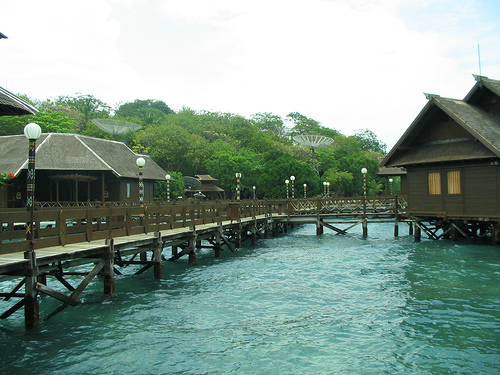
30 minutes from Marina Ancol to the north is another piece of heaven, Ayer Island. The beauty of this island will allow you to forget that you are only 14 kilometers away from frenzied of Jakarta. In the family of Pulau Seribu, Ayer is one of the larger island, covering60 hectares area, surrounded by beach. In the afternoon, the beauty of the island is complemented by the most beautiful sunset in Jakarta. No wonder that this island has attracted kings and the first President of Indonesia. Cottages and bungalow on this island are influenced by traditional indonesian decor. With the crystal clear ocean, water sports are a favourite activity, although billiards, karaoke and meeting facilities are also available.
 Bidadari (Meaning angel) is one of the nearest islands from Jakarta, reachable in only 20 minutes by speedboat. This Island offers a beautiful view from cottages built amongst the trees. The shady, comfortable environment allows you to feel at one with nature. Visit a real fisherman’s raft floating on the sea to complete the experience. This island is a perfect base from which to tour the neighboring islands of kahyangan, Kelor and Onrust, where historical remains from the Dutch East Indies Company of the 17th century are well preserved.

On this exotic island, experience the wonderful clear water, with visibility from 10 to 15 meters, offering an exceptional view of tropical fish and coral. Besides outdoor sports and water sports, Matahari Island offers beautiful sunrises and sunsets. Sunrise in the east port and sunset in the west port are a double treat. For an evening’s entertainment, the resort has the Bamboo Bar with karaoke, disco and movie facilities. Meeting facilities are also available, along with fully furnished cottages. The cottages have been built around the shoreline so you can also watch the spectacular sunset and sunrise from your balcony.

Putri (meaning princess) offers the beauty of paradise with its soft and white sandy beach with crystal clear water all around. The cottages are surrounded by green leafy gardens and traditional furnishings. For pleasure and leisure, this place is ideal for sports such as scuba diving, snorkeling, fishing, canoe riding, with facilities including a glass bottom boat, semi-submersible and undersea aquarium. Built in 1992 the 25 x 10m, the undersea aquarium allows you to view sharks, coral and many other sea creatures.

The famous diving site is only 90 minutes away from jakarta’s bustle. This tropical atoll has been kept in its original pristine state, the flora and the fauna undisturbed by cozy cottages tucked amongst the foliage, looking out to the sea. In this peaceful place, you can hear the sound on the wind in the trees along with singing birds and gentle waves lapping the shore. Alam kodok provides diving package for various budgets as well as a complete range of diving equipment.

This island has the biggest resort and a golf course, Bira Besar Cottages & Golf Resort. This is not only a golfers pleasure but also a family venue for a place of natural bauty and complete rest and recreation. Beside the main 9-hole golf course, you can also enjoy a variety of activities, from fishing to canoeing and a afull range of outdoor and water sport facilities. This place provides a complete range of activities for family vacations.


